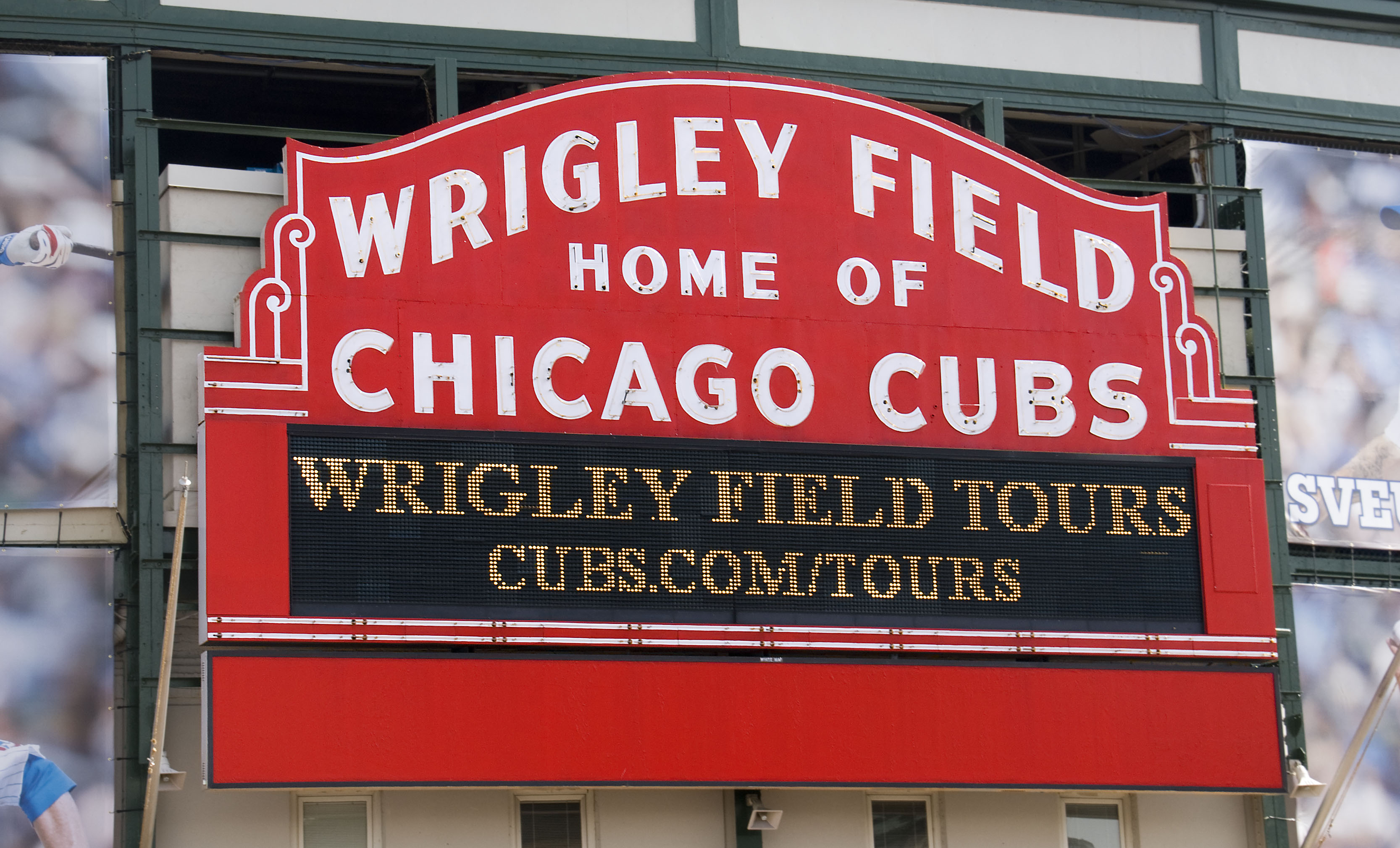
The logo dropped Thursday at Wrigley during a Cubs-Twins game. Behind the marquee-and-star design sits a $32.1 million public-private security deal — and a labor deadline that could still cancel everything.
The logo appeared on the Wrigley scoreboard during Thursday's Cubs-Twins game, unveiled at home plate by outfielder Pete Crow-Armstrong: a red banner that replicates the park's famous home-plate marquee, a Cubs-blue star as its backdrop, and the six-pointed emblem from Chicago's municipal flag worked into the geometry. It looks like the ballpark. That was the point.
The 2027 MLB All-Star Game is scheduled for July 13 at Wrigley Field — the Home Run Derby the night before, the MLB Draft part of the hosting package. When it happens, Wrigley will become the first active ballpark in history to host four All-Star Games, having done so in 1947, 1962, and 1990. The last one was 37 years ago; the Chicago of that summer had a different skyline, a different mayor, and a very different asking price.
Cubs chairman Tom Ricketts pursued hosting rights for eight years. What finally unlocked them wasn't the $1 billion the Ricketts family spent renovating the park across the 2010s — it was a perimeter security ordinance. MLB Commissioner Rob Manfred said last year that security infrastructure was "the last issue that needed to be resolved." The total package came to $32.1 million: Illinois committed $12 million, the City of Chicago roughly $10 million, and the Cubs around $10 million. That money bought anti-terrorism-rated bollards, a four-foot widening of Addison Street, relocated light poles, and utility work spread across two off-seasons. Taxpayers are covering roughly two-thirds of the tab, with no revenue-sharing terms disclosed publicly.
What the public bought, in market terms: a floor of $5,017 on the secondary market for a game ticket, per current listings on Gametime — versus a $63 average for a regular-season Wrigley seat. The city that subsidized the security perimeter will watch the event from that distance, unless it has season tickets. The Cubs did offer full season-ticket holders guaranteed All-Star access, contingent on renewing through 2028.
One caveat the logo can't paper over: the MLB Collective Bargaining Agreement expires in December 2026. If a lockout follows, the game goes with it — along with the public investment in a neighborhood that spent two off-seasons under construction. 44th Ward Alderperson Bennett Lawson negotiated a Friday/Saturday night-game restriction on the Cubs as part of the community agreement; that protection survives a lockout. The $22 million from Springfield and City Hall does not.
The marquee on the logo glows. The math underneath it is messier than it looks.